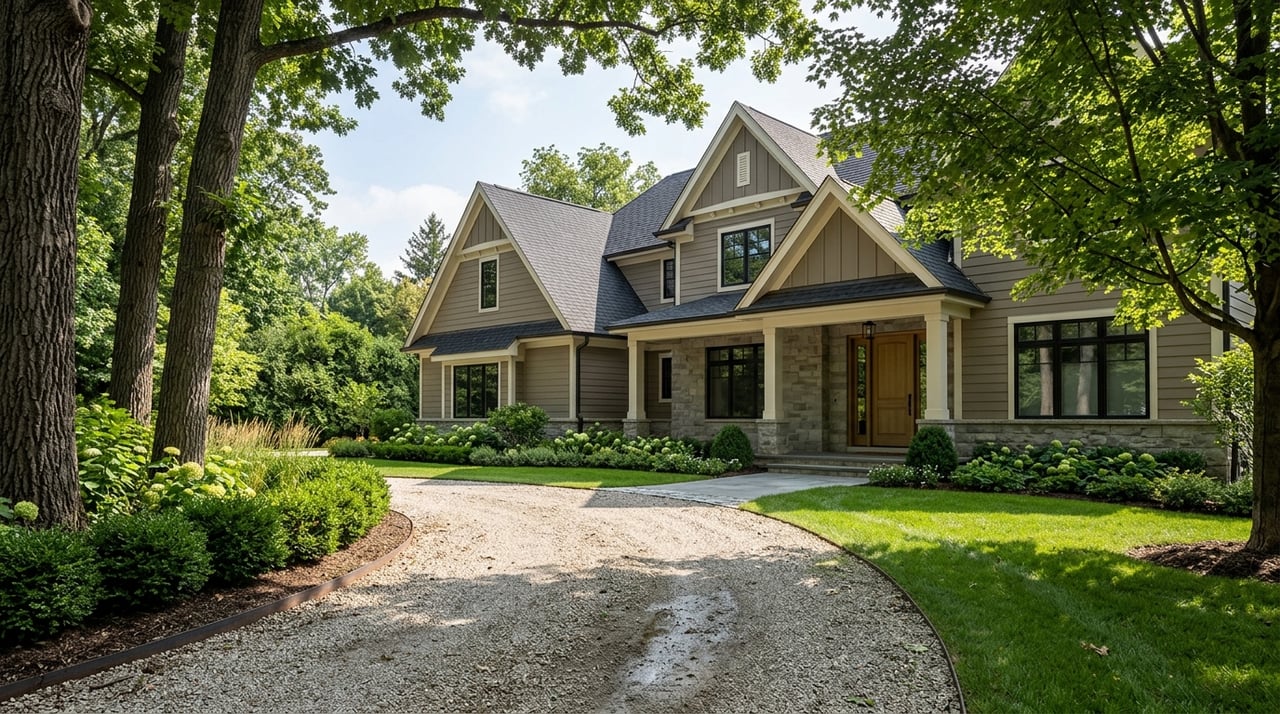
Building Your Custom Home in Indian Hill: Lot to Move-In
April 16, 2026
April 16, 2026
If you are planning to build a custom home in Indian Hill, the house itself is only part of the story. In this market, your lot, approvals, and site conditions can shape the project just as much as your floor plan or finishes. The good news is that when you understand the process early, you can make better decisions, avoid expensive surprises, and move forward with more confidence. Let’s dive in.
In Indian Hill, lot selection is not just about finding enough space for the home you want. The village places a strong emphasis on preserving its rural residential character and open space, which affects how land is reviewed and developed. The village’s long-running Green Areas program reflects that broader planning approach.
That means the lot often determines the project more than the floor plan does. Before you get attached to a design, you need to understand the buildable area, setbacks, drainage, access, and any other site-specific constraints. In many cases, the real question is not “Can I design this home?” but “Can this lot support this home?”
Indian Hill also keeps zoning information relatively accessible. You can start with the village’s planning and zoning documents to review the zoning map and address-based zoning classifications before you commit to land or a teardown opportunity.
A custom build in Indian Hill starts with due diligence. If you skip this step or rush through it, you risk redesign costs, approval delays, or a project that cannot move forward as planned.
Hamilton County’s Auditor notes that aerial imagery and parcel maps are approximate, not exact. Exact property lines come from the deed, and the safest way to confirm them is through a licensed surveyor who reads the deed and stakes the lines. The Auditor also makes clear that zoning is handled by the local jurisdiction, not the Auditor, which is why both county and village review matter at the front end. You can review those details through the Hamilton County Auditor FAQ.
These are not minor details. Indian Hill’s own site-clearance materials warn that subdivision restrictions may prohibit certain accessory structures, and demolition-related review requires applicants to check deed restrictions and historical-significance issues before tearing down an existing structure.
Indian Hill zoning standards are larger and more restrictive than what many buyers expect in a typical suburban market. That is one reason why early feasibility review is so important.
According to the village zoning ordinance, minimum lot area for dwellings is:
The same ordinance states that lot coverage is limited to 20 percent in Districts A and B and 25 percent in District C. Principal structures may not exceed 40 feet in height, and accessory structures may not exceed 30 feet.
Those standards can influence almost every design decision, including house placement, driveway layout, garage configuration, outdoor living areas, and accessory buildings. Even a beautiful plan may need changes if it does not fit the zoning envelope of the lot.
Topography and water management are major parts of custom-home planning in Indian Hill. A lot may look ideal at first glance, but grading challenges or runoff issues can significantly affect cost, design, and approvals.
The village’s site-clearance release application requires a registered-surveyor property survey, easement locations, proposed and existing building locations, driveway location, lot and structure elevations, and drainage features on the plot plan. It also requires erosion-control measures to be in place before excavation begins.
Indian Hill’s storm water management page adds another layer. The village says detention and stormwater quality treatment are required for developments with 1,000 square feet or more of new impervious surface and-or 5,000 square feet or more of disturbed area. The site-clearance application also states that a Notice of Intent is required for one acre or more of disturbed area.
For you as a buyer or landowner, the takeaway is simple: stormwater is not a late-stage issue. It should be part of the feasibility conversation before you finalize your lot purchase or approve a full design package.
One of the most common misconceptions about custom construction is that there is a single permit that gets the project moving. In Indian Hill, the process is better understood as a sequence of reviews and approvals.
Start with the zoning district, deed, survey, easements, and restrictions. This is the stage where you identify whether the lot fits your goals or whether the design will need adjustments.
Once the lot is understood, your plans should respond to setbacks, coverage limits, drainage, access, and utility needs. In Indian Hill, site fit matters as much as style.
The village’s site-clearance release application is a key early step. The form requires two sets of building plans, two copies of plot plans, a detailed construction timetable, and survey and drainage information. It also states that fire-hydrant access must be within 400 feet of a new dwelling and that the review fee is $50.
If your project affects the public right-of-way, approval is required for work such as driveways, culverts, curb cuts, grading, ditching, retaining walls, and utility work. The village states in its site-clearance materials that it may issue a stop-work order and require a bond for noncompliance.
Indian Hill has a dedicated inspections department, and septic-related oversight may also involve Hamilton County Public Health. If the property depends on a household sewage disposal system, that coordination can become an important part of the timeline.
Not every property fits neatly within standard zoning rules. The good news is that Indian Hill has an established process for lot-specific issues.
The village says its Planning Commission reviews subdivisions, code variances, and special exceptions, and it also hears certain zoning and subdivision appeals. The zoning ordinance allows special exceptions and variances, with review factors that include neighborhood character, access, drainage, utilities, historical resources, and the applicant’s ability to complete and maintain the project.
That matters because nonconforming lots, setback adjustments, and similar requests are part of the real local process. Indian Hill’s 2024 activity included approvals and review items involving a new single-family residence on a non-conforming lot, setback variances, and plan adjustments, according to the village’s annual reporting.
The most honest answer is that the timeline depends on the lot, the plan, and the completeness of your package. It is better to think in terms of sequence and risk points than to rely on a fixed number of months.
Indian Hill requires a timetable with the site-clearance application. Depending on the property, your project may also require Planning Commission review, revisions to drainage or layout, or septic coordination. In other words, the biggest delays often happen before major construction begins.
A disciplined front-end review can save significant time later. In Indian Hill, the pre-construction phase is often where the project is won or lost.
If you are buying land, your main job is to verify feasibility before you close. If you are buying an older home with teardown potential, you should review the same issues plus any demolition-related restrictions or historical concerns.
If you are selling land or a teardown property, strong documentation can make a major difference. Clear survey information, zoning context, and realistic guidance on approvals can help attract better-informed buyers and reduce friction during due diligence.
Indian Hill remains an active but carefully managed custom-home market. In its 2024 Annual Report, the village said it issued 245 site-clearance release permits in 2024, including 25 new homes, and reported that 204 new homes were built over the prior 10 years, averaging 20.4 per year. That tells you new construction is happening, but within a process-driven framework.
A custom build in Indian Hill involves more than choosing finishes and hiring a builder. You are evaluating land, zoning, drainage, approvals, and timing, often all at once. That is why having an advisor who understands the local process can be valuable from the very beginning.
At Luther Group Real Estate, we help buyers and sellers navigate complex decisions involving land, teardown opportunities, and custom-home projects in Indian Hill and across Greater Cincinnati. If you are weighing a lot purchase, preparing to sell land, or trying to understand whether a property is buildable for your goals, we are here to help you map out the next steps.
Stay up to date on the latest real estate trends.


We pride ourselves in providing personalized solutions that bring our clients closer to their dream properties and enhance their long-term wealth.
LUTHER GROUP REAL ESTATE
9321 Montgomery Road Cincinnati OH 45242 Coldwell Banker Realty