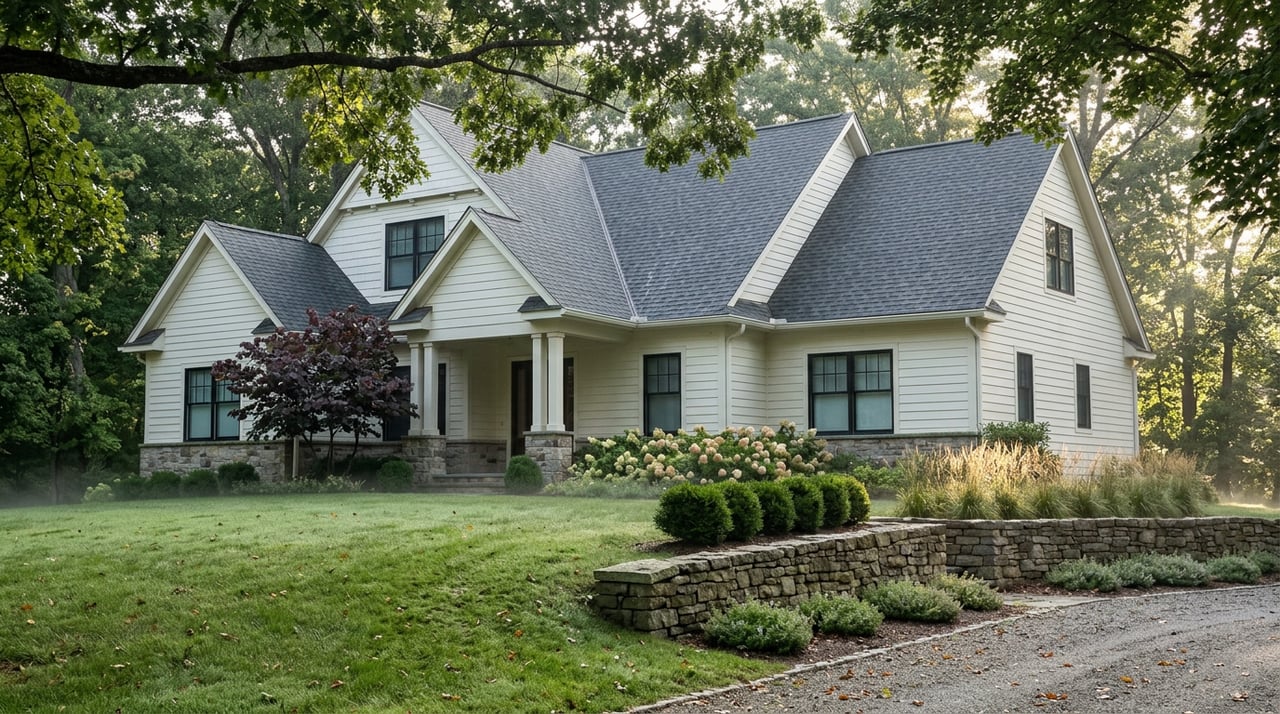
In Indian Hill, Septic Compliance Is a Standing Law, Not a Closing-Day Checkbox
August 13, 2026
August 13, 2026
Most of Hamilton County treats a septic system the way most of Ohio does: a box to check when a property changes hands. Get it inspected, fix what fails, close the sale. Indian Hill doesn't work that way.
The Village runs its own ordinance requiring an inspection of every household sewage disposal system every year, whether or not the home is for sale. It hires its own inspectors to do it. And that difference matters more than it sounds like it should, especially in a market where the average estate now sits on the market for roughly two months and every week of delay gets noticed.
The Village of Indian Hill's inspections page is direct about it: the Village has its own ordinance regulating household sewage disposal systems, and that ordinance mandates an annual inspection of each system. The Village employs its own inspectors to carry this out, separate from the general public health services Hamilton County provides for schools, pools, and other programs.
That's a meaningfully different setup than what governs most of the rest of the county. Hamilton County Public Health, which is home to roughly 20,000 sewage treatment systems across the county, generally inspects mechanical systems yearly and non-mechanical systems every five years as its own baseline. Indian Hill doesn't lean on that five-year window. Its ordinance calls for a look at every system, mechanical or not, once a year, every year.
The inspectors themselves show up in person. They carry identification and are instructed to contact residents who are home before inspecting, according to the Village's own description of the program. That's a detail worth sitting with if you split time between homes, travel for work, or hold the property in a trust managed at a distance. An inspection program built around door-to-door contact assumes someone is reliably there to answer it.
Ohio's septic rules are set at the state level through the Ohio Administrative Code, but enforcement is local, and local means genuinely different from one jurisdiction to the next.
| Jurisdiction | When an inspection happens | Who does it |
|---|---|---|
| Village of Indian Hill | Every system, every year, sale or no sale | Village-employed household sewage disposal inspectors |
| Hamilton County (general baseline) | Mechanical systems yearly, conventional systems every five years | Hamilton County Public Health |
| Summit County (for comparison) | Once, before the property transfers, unless exempted | Registered evaluator, filed with Summit County Public Health |
Summit County's model, which requires an inspection before any residential property with a septic system or private well can transfer, is closer to what most sellers expect: a one-time gate you clear before closing. Indian Hill's ordinance isn't a gate you approach once. It's a standing requirement that's supposed to already be satisfied, year after year, long before a listing goes live.
The inspection itself isn't the problem. A properly maintained system on a well-kept lot passes without much drama. The risk is the gap.
Because Indian Hill's inspectors initiate the visit rather than waiting for an owner to request it, a system can go uninspected, or under-documented, for longer than the ordinance intends without anyone treating it as urgent. Nobody's actively breaking a rule in the moment. But when a home goes under contract, a buyer's attorney or lender is going to ask for the inspection history, and "it's been a while" is not the answer anyone wants to give three weeks before a scheduled closing.
That question lands harder on Indian Hill's estate lots than it would almost anywhere else in the region. Homes here commonly sit on three to five acres, terrain that's frequently wooded or sloped rather than flat, supporting systems built for five- and six-bedroom houses rather than a standard suburban footprint. A system that needs more than a routine pump, because the last real inspection was years ago rather than months, can take longer to diagnose and remedy on ground like that. That's time a seller loses at the exact point in a transaction when buyers are watching the calendar closest.
Buyers have a resource here too. Hamilton County Public Health offers a voluntary septic inspection service to prospective home buyers ahead of a purchase, specifically to help them avoid unforeseen repair costs. It's worth using even when the Village's own annual inspection is current, because it gives a buyer a second, independent read before they're contractually committed.
Septic isn't the only system that gets extra scrutiny on a private, unsewered lot. If the home also relies on a private well, which is common across the village, financing adds its own requirements.
FHA-insured loans require water testing whenever a home is served by a private well, per HUD guidance referenced by the Water Systems Council. VA loans carry a similar requirement, and VA water tests are only valid for 90 days from the certification date, according to Veterans United's published lending guidance. A cash buyer can move past this. A buyer financing with FHA or VA cannot, and if that testing hasn't been scheduled early, it becomes one more item competing for time against an already tight closing window.
Ohio has roughly one million homes on private wells statewide, according to Ohio State University's extension service, so this isn't a rare situation. It's simply one more layer that estate sellers need to plan for rather than discover midway through escrow.
None of this is theoretical timing pressure. It's real, and it's visible in how the village is trading right now.
Indian Hill's inventory stays thin by design. Estate-scale lots rarely reach the open market, and even completed homes trade in small numbers. Redfin's three-month rolling median for the village reached roughly $1.81 million as of May 2026, while Zillow's average home value estimate stood near $1.66 million and Realtor.com's median list price ran closer to $2.1 million around the same time. The spread between those numbers isn't a data error. In a market this thin, a single estate sale can move the median by hundreds of thousands of dollars from one reporting period to the next.
What's consistent across every source is the pace. Recent 30-day snapshots have shown roughly 18 homes selling at a time, with average days on market running near 61, well above the faster pace seen across the broader Cincinnati metro. Sellers have still held pricing power, with the typical home selling at or slightly above list. But that pricing power exists because well-prepared homes stand out in a market with few competing options, not because buyers are willing to wait out unresolved problems.
The estate at 9075 Indian Ridge Lane closed on July 17, 2026, for $1.8 million. A five-acre, 5,130-square-foot estate at 8180 Keller Road came onto the market in mid-July 2026 asking $1,950,000. Neither listing had room to lose momentum to something as fixable as a lapsed inspection record. In a market where buyers already have few properties to compare, a septic surprise doesn't just cost a seller a week. It gives a buyer a reason to keep looking, or to renegotiate from a position they didn't have a month earlier.
Does the annual inspection cover my well too, or just the septic system? Just the septic system. Private wells fall under Ohio's separate private water system rules, and if your home draws from a well, plan for water testing as its own line item, not something the septic inspection satisfies.
I've owned my home for years and don't recall an inspection. What now? Because Village inspectors initiate contact rather than waiting for a request, it's worth confirming your inspection history directly with the Village before you list, rather than assuming silence means compliance.
Can I schedule my own inspection ahead of a Village visit? Yes, and timing it deliberately, so your record is current the moment you go active, removes one more variable a buyer's attorney could otherwise flag during due diligence.
An estate sale in Indian Hill has enough moving pieces without a septic record becoming one of them. If you're weighing a sale or a purchase here and want a clear-eyed read on where your property stands, from the septic file to the current comparables, Luther Group Real Estate is ready to help. Schedule a consultation and let's get ahead of the details before they get ahead of you.
Stay up to date on the latest real estate trends.




We pride ourselves in providing personalized solutions that bring our clients closer to their dream properties and enhance their long-term wealth.
LUTHER GROUP REAL ESTATE
9321 Montgomery Road Cincinnati OH 45242 Coldwell Banker Realty